What are the key drivers of food waste in Singapore and around the world?
Image by Freepik
Introduction
Food waste is a major global problem (UNEP, 2022). According to the United Nations Environment Programme (UNEP) (2022), it is estimated that 1/3 or 30% of the world’s food produced for human consumption was lost or wasted on a global scale, totaling around 1.3 billion tons annually (FAO, 2011; UNEP, 2021; UNEP, 2022). Additionally, food waste contributes to global greenhouse gas emissions, estimated at 8 - 10%, intensifying climate change (UNEP, 2021).
What is Food Waste?
According to the United Nations' Food and Agricultural Organisation (FAO),"food waste" refers to the discarding or non-food use of products that are safe and nutritious for human consumption.
Do you know that household accounts for most of the food waste?
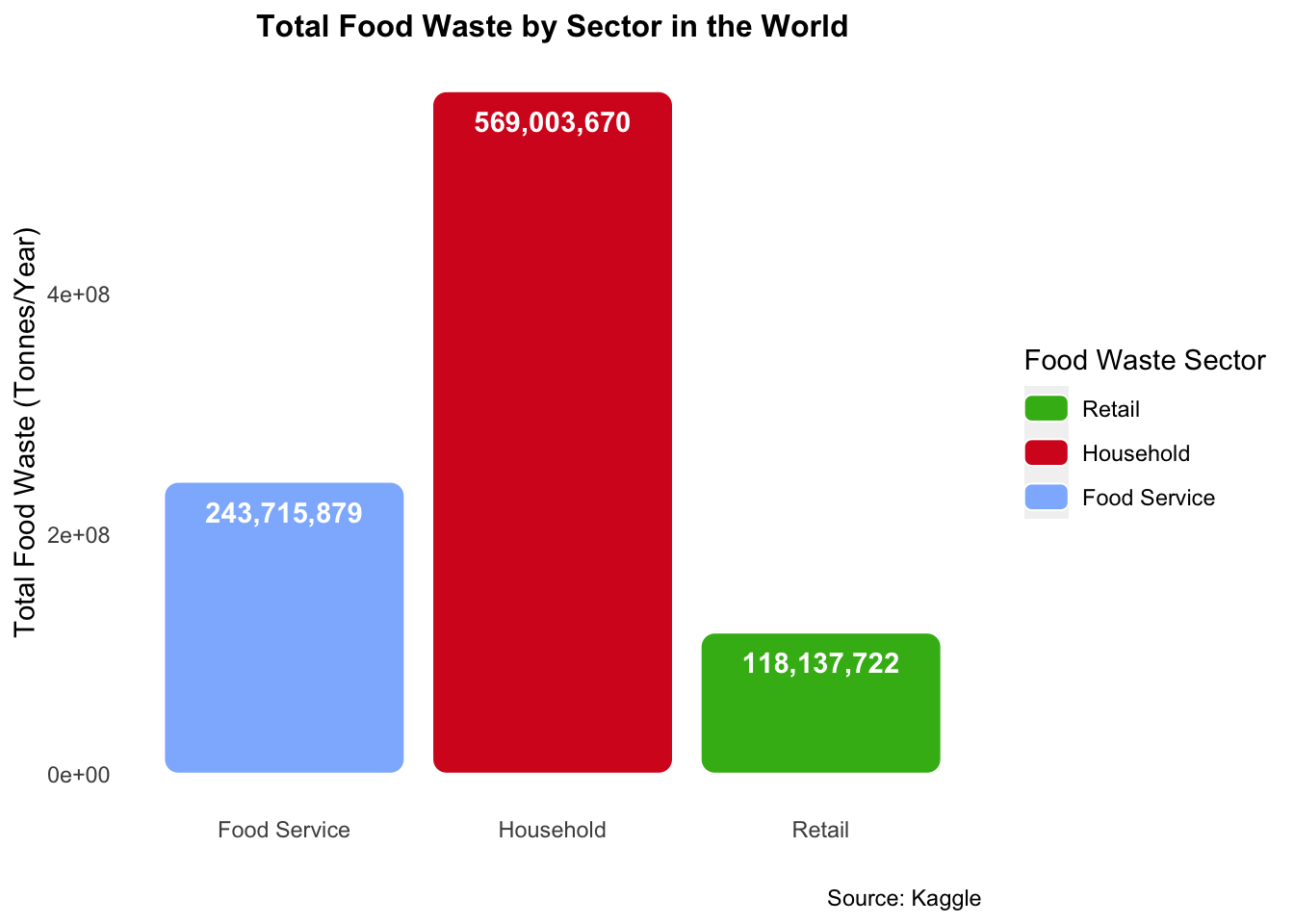
The chart shows that households are the largest contributors to food waste, accounting for 61.1% of the total. This is followed by food services 26.2% and retail establishments 12.7%.
Which Country Generated the most Household Food Waste?
Let's see it from the World Map
At first glance, we can see that China, followed by India, has generated the most household food waste. This is not surprising as they are the most populous countries in the world.
Let's take a closer look...
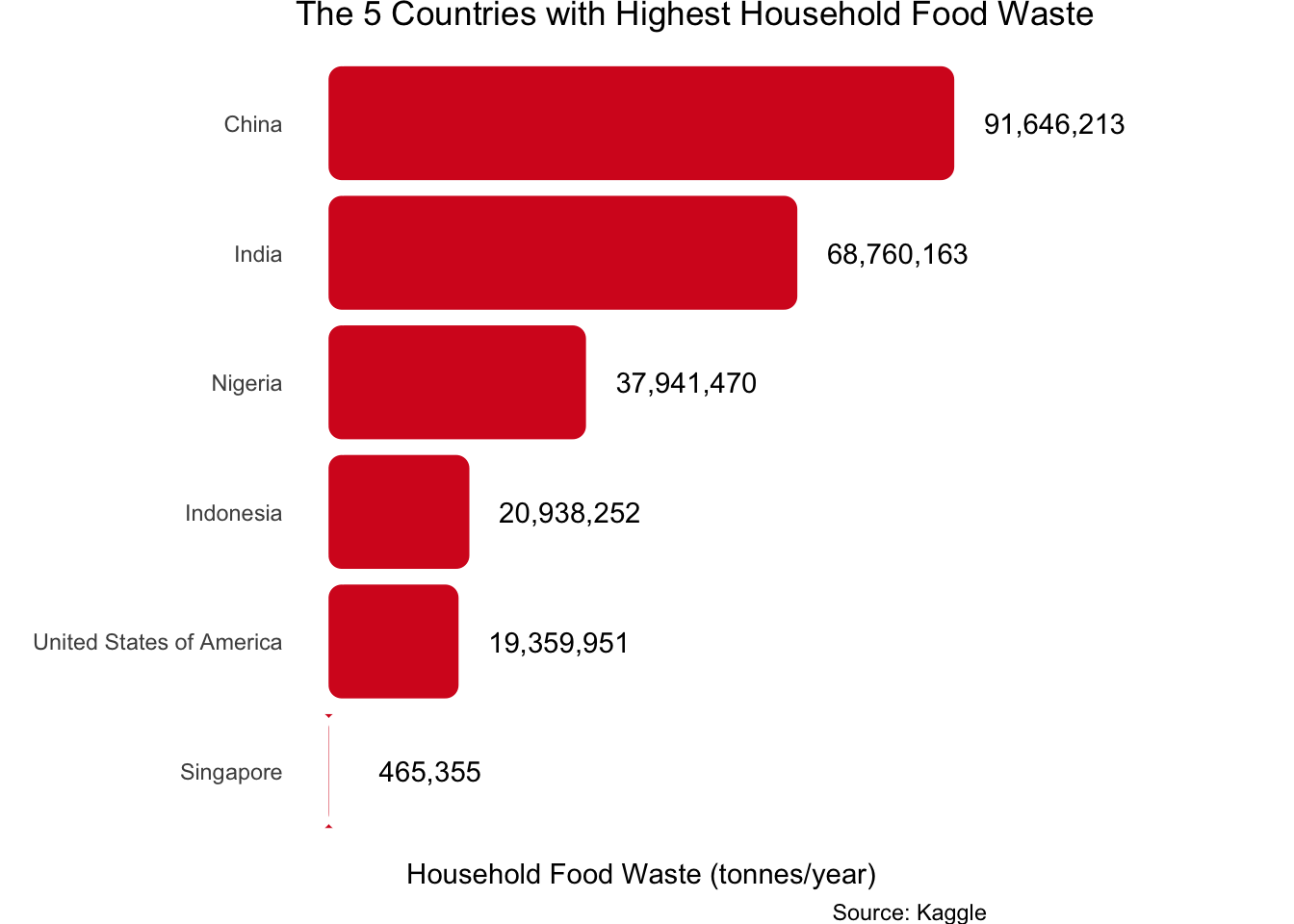
China and India, the two most populous countries in the world, also produce the most household food waste. In 2021, China produced an estimated 92 million metric tons of household food waste, while India produced 69 million metric tons. This accounts for nearly one-third of the world's total household food waste.
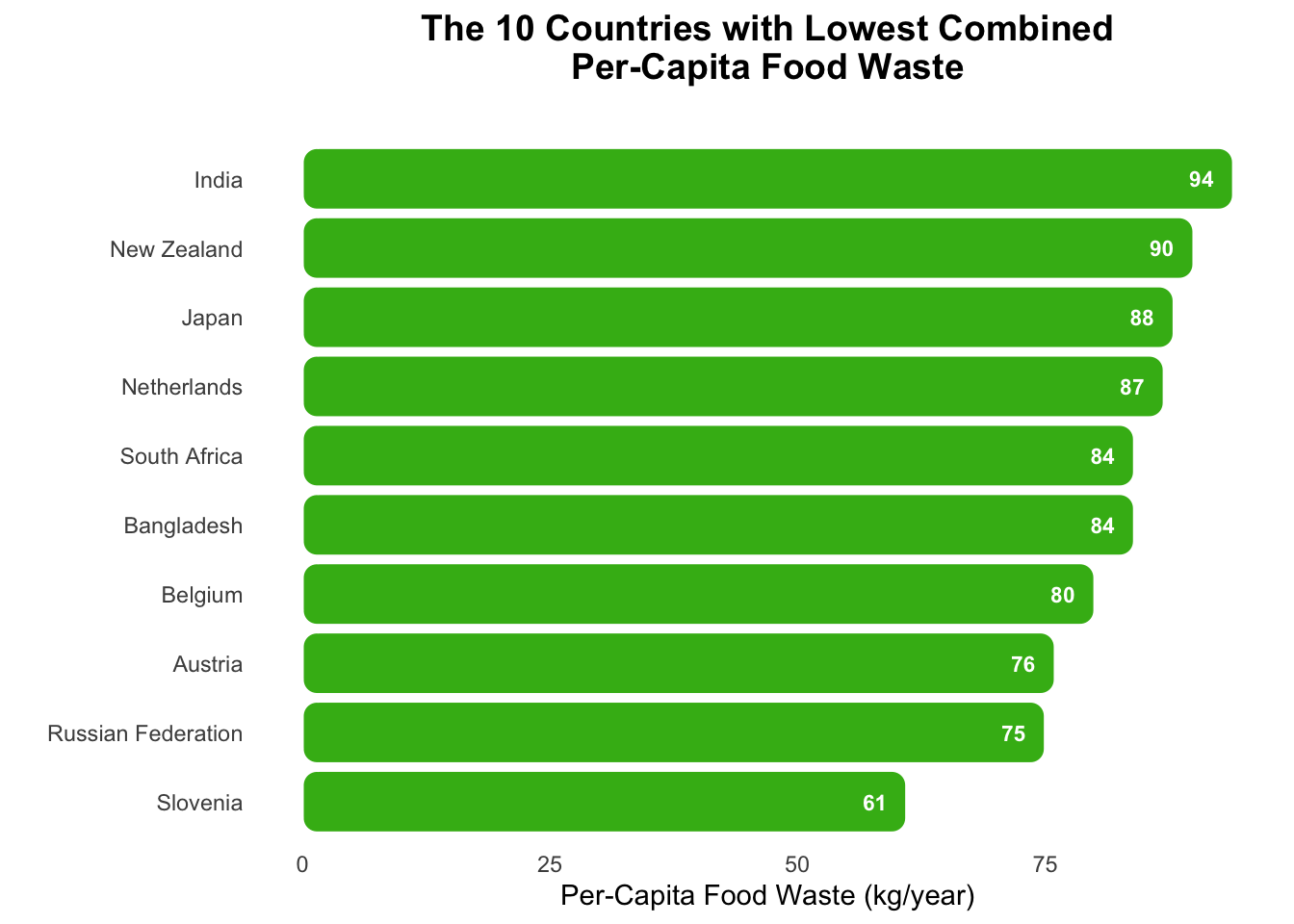
What are the Top 10 and Bottom 10 Countries for Combined per-capita Food Waste?
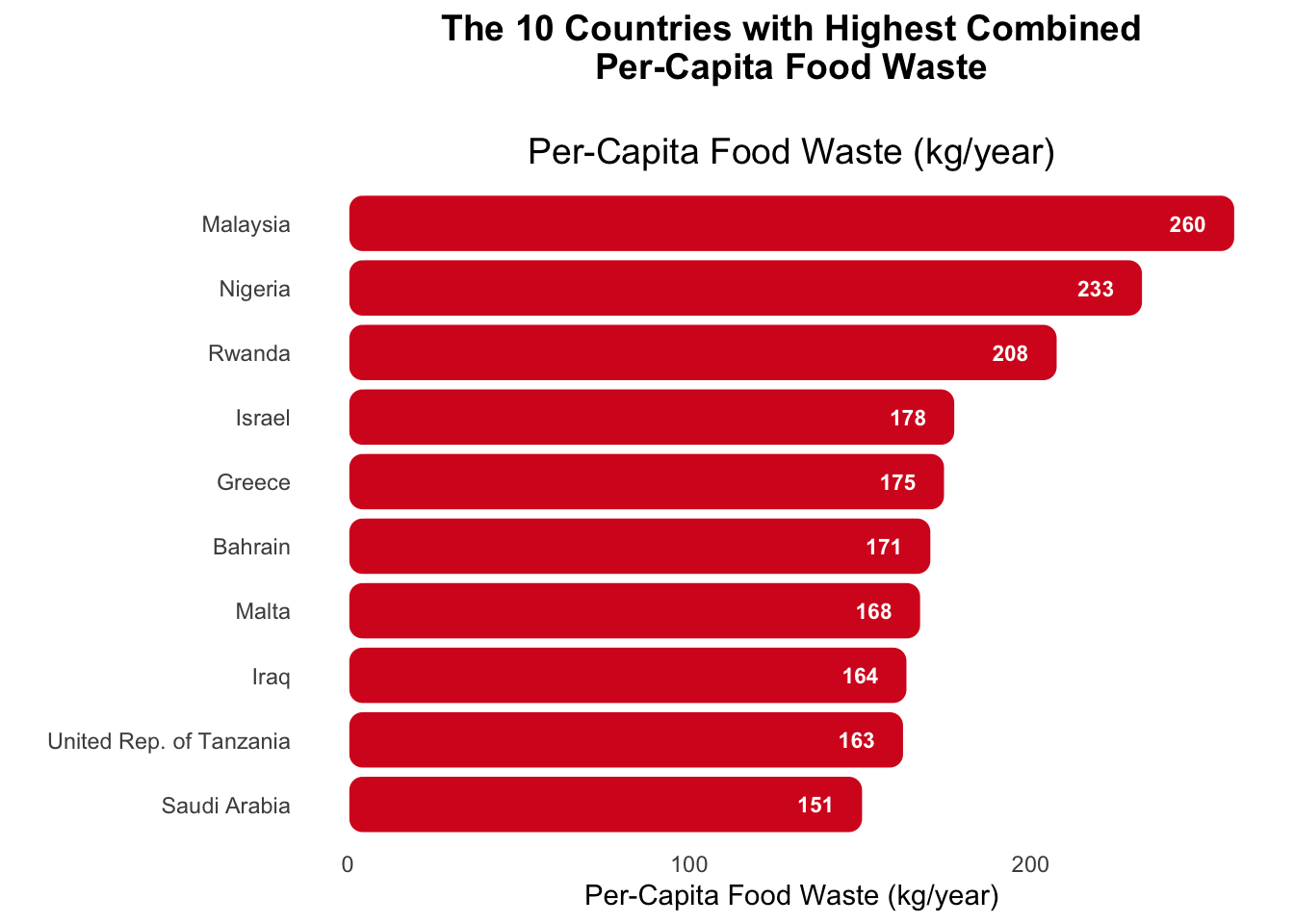
Top 10 Countries
The majority of the top 10 countries are situated in Sub-Saharan Africa (or Africa) and the Western Asia (or Middle East), regions known for their comparatively lower levels of socioeconomic development. According to International Monetary Fund (IMF) (2021), Sub-Saharan Africa was projected experience the slowest economic growth compared to other region in the world in 2021. Additionally, Sub-Saharan Africa and Western Asia's Gross Domestic Product (GDP) per capita figures of approximately USD$1626.28 and USD$6266.36, respectively, among the lowest in the world (O'Neill, 2023).
Bottom 10 Countries
The majority of the bottom 10 countries are exhibiting the lowest food waste per capita are situated in Western Europe, which is renowned as a highly developed region globally.
Food Waste in Singapore
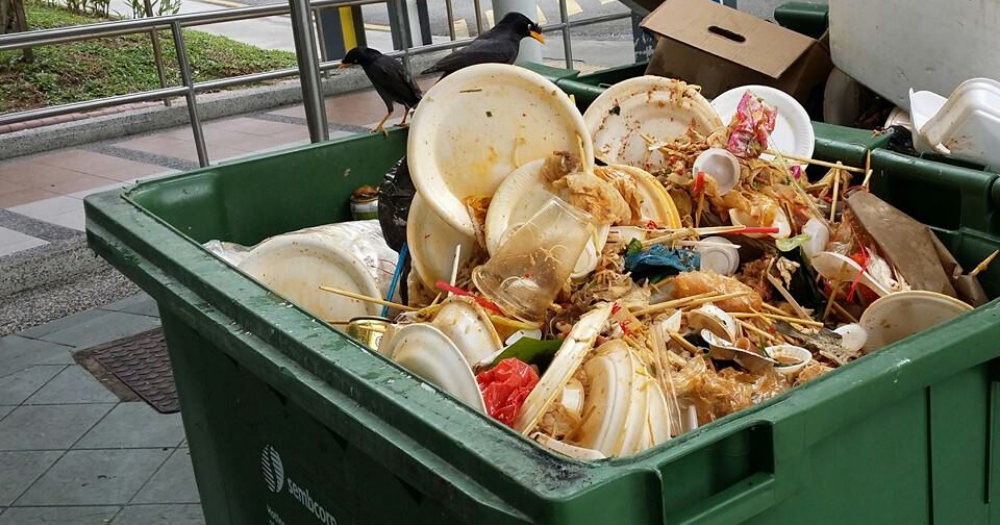
Image by Mothership
In 2019, Singapore produced approximately 744 million kilograms of food waste, which translates to the consumption of 2 bowls of rice per person daily or the volume of about 51,000 double decker buses (Towards Zero Waste, n.d.). This alarming level of food waste poses a significant challenge in Singapore, impacting food security and straining vital resources. This issue is particularly critical considering Singapore's heavy reliance on importing more than 90% of its food and its limited land availability (Towards Zero Waste, n.d.).
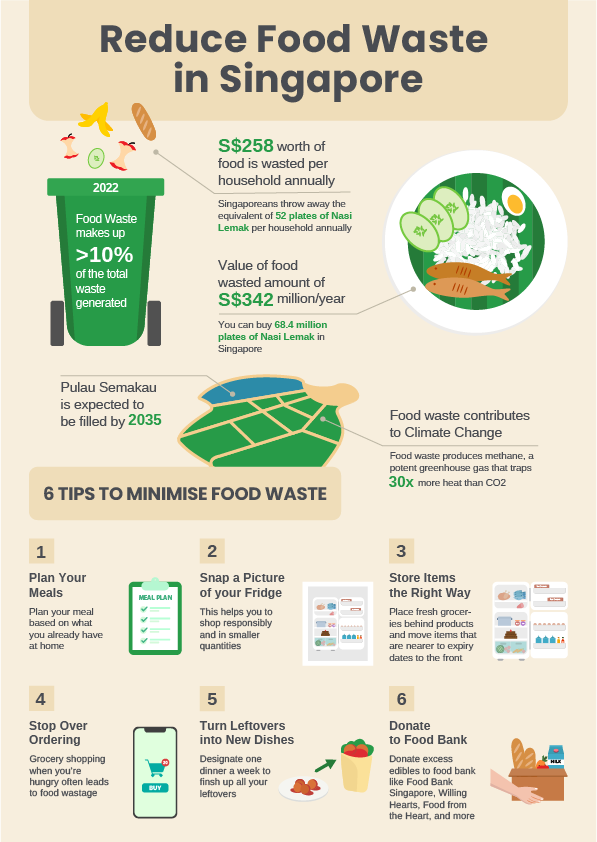
Singapore generated 763,000 tonnes of food waste in 2022 and this accounted for 11% of total waste (NEA, n.d.). This amount has increased steadily over the years, and it is expected to continue to grow as the population and economy expand.
Food waste ranks among the top 3 type of waste generated in Singapore, trailing behind paper/cardboard and plastic waste. Both Ferrous metal and paper/cardboard have a recycling rate of 99%. Go to the Dashboard to find out more. The "Others" types is the combimnation waste type that accounts for less than 6% of the total waste.
How does Singapore compared Countries in South-Eastern Asia?
In the South-Eastern Asia region, Singapore ranks 9 out of 11. It produces a relatively low amount of food waste, totaling only 688,134 tonnes per year compared to other Southeast Asian countries. Currently, Indonesia holds the title for the highest amount of wasted food in Southeast Asia, with 32,653,175 tonnes per year.
Does this suggest that Singapore can overlook the food waste problem?
NO! as Pulau Semakau is expected to be filled by 2035 (MSE, 2020). Additionally, food waste produces methane, a greenhouse gas that traps 30x more heat than CO2 (Zheng, 2019).
Tips to Reduce Food Waste in Singapore
Tip 1 Plan Your Meals
Plan your meal based on what you already have at home.
Tip 2 Snap a Picture of your Fridge
This helps you to shop responsibly and in smaller quantities.
Tip 3 Store Items the Right Way
Place fresh groceries behind products and move items that are nearer to expiry dates to the front.
Tip 4 Stop Over Ordering
Grocery shopping when you’re hungry often leads to food wastage.
Tip 5 Turn Leftovers into New Dishes
Designate 1 dinner a week to finish up all your leftovers.
Tip 6 Donate to Food Bank
Donate excess edibles to food bank like Food Bank Singapore, Willing Hearts, From from the Heart, and more.
Conclusion
Food waste stands as a pressing global concern, with approximately one-third of the world's produced food for human consumption going to waste. The issue spans from households to commercial establishments, contributing significantly to greenhouse gas emissions and exacerbating climate change. Regional disparities reveal both socioeconomic and developmental influences, emphasizing the need for immediate action on both individual and systemic levels.
Singapore, despite producing relatively less food waste compared to its regional counterparts, faces critical challenges due to its reliance on food imports and limited space. The impending waste management crisis and environmental repercussions underscore the urgency in addressing food waste. Practical solutions, from mindful meal planning to donating excess food, offer tangible steps toward curbing waste. However, comprehensive efforts involving behavioral shifts, policy interventions, and community engagement are essential to cultivate a sustainable culture around food consumption and waste reduction.
Development Bank of Singapore (DBS). (n.d.). 5 tips on reducing food waste. https://www.dbs.com/livemore/food/5-tips-on-reducing-food-waste.html
Food and Agriculture Organization. (n.d.). The State of Food and Agriculture - 2019. https://www.fao.org/state-of-food-agriculture/2019/en/
Food and Agriculture Organization of the United Nations (FAO). (2011). Global food losses and food waste – Extent, causes and prevention. Rome. https://www.fao.org/3/mb060e/mb060e00.htm
Lee, B. (2023, May 25). Love Food, hate waste: 8 easy ways to reduce food waste in Singapore. https://thehoneycombers.com/singapore/stop-food-waste-singapore/
Ministry of Sustainability and the Environment (MSE). (2020, January 14). Saving Semakau — One island’s role in managing Singapore’s waste. https://www.mse.gov.sg/resource-room/category/2020-01-14-newsletter-saving-semakau-one-island-role-in-manaing-singapore-waste/
National Environment Agency (NEA). (n.d.). Waste Statistics and Overall Recycling .https://www.nea.gov.sg/our-services/waste-management/waste-statistics-and-overall-recycling
O'Neill, A. (2023, February 2).Gross domestic product (GDP) per capita in selected global regions at current prices in 2021. https://www.statista.com/statistics/256413/gross-domestic-product-per-capita-in-selected-global-regions/
Selassie, A. A., & Hakobyan, S. (2021, April 15). Six charts show the challenges faced by Sub-Saharan Africa. International Monetary Fund (IMF). https://www.imf.org/en/News/Articles/2021/04/12/
Towards Zero Waste. (n.d.). Food Waste. https://www.towardszerowaste.gov.sg/foodwaste/
United Nation Environment Programme (UNEP). (2021). UNEP Food Waste Index Report 2021.https://www.unep.org/resources/report/unep-food-waste-index-report-2021
United Nation Environment Programme (UNEP). (2022, September 26). Why the global fight to tackle food waste has only just begun. https://www.unep.org/news-and-stories/story/why-global-fight-tackle-food-waste-has-only-just-begun
Zheng, Z. (2019, May 16). Food waste worsens climate change more than plastics: Zero waste Scotland report. https://mothership.sg/2019/05/food-waste-worsens-climate-change-more- than-plastics-zero-waste-scotland-report/
Arvidsson, J. (n.d.). Food Waste [Data set]. Kaggle. https://www.kaggle.com/datasets/joebeachcapital/food-waste
National Environment Agency (NEA). (n.d.). Waste Statistics and Recycling Rate from 2003 to 2016 [Data set]. https://www.nea.gov.sg/docs/default-source/our-services/waste-management/wastestats-2003-20164197a3fd04d34770bafba09393d0fdf0.pdf
National Environment Agency (NEA). (n.d.). Waste Statistics and Recycling Rate from 2017 to 2021 [Data set]. https://www.nea.gov.sg/docs/default-source/default-document-library/waste-and-recycling-statistics-2017-to-2021.pdf
National Environment Agency (NEA). (n.d.). Waste Statistics and Recycling Rate for 2022 [Data set]. https://www.nea.gov.sg/our-services/waste-management/waste-statistics-and-overall-recycling